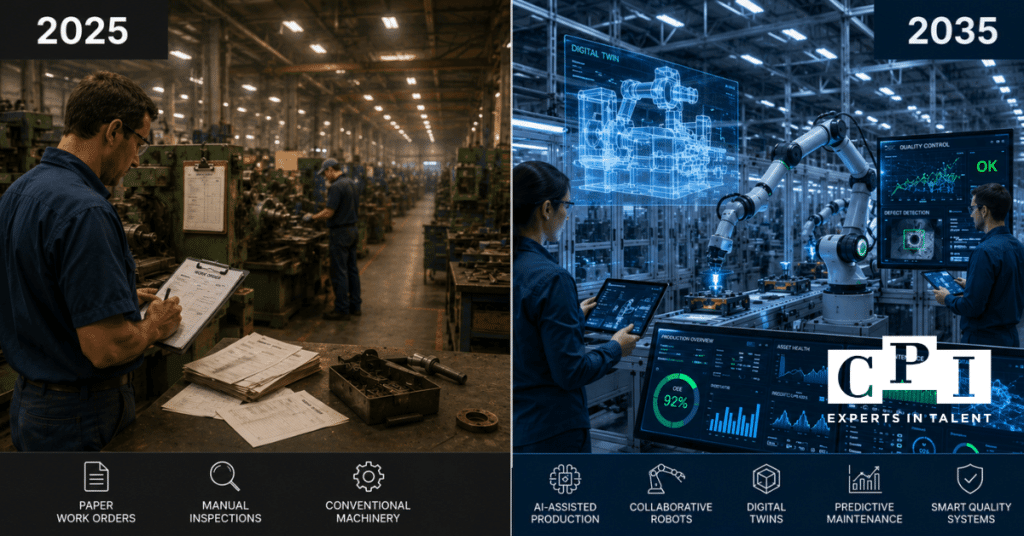
Future factory manufacturing jobs will look very different by 2035 than they do today.
While factories will still need skilled workers, the jobs themselves will continue to evolve. Artificial intelligence, automation, connected systems, and advanced robotics are already changing how products move from concept to customer.
As a result, employers will need workers with technical expertise, adaptability, and strong problem-solving skills. Companies that prepare now will have a significant advantage in attracting and retaining the talent needed to compete.
According to the World Economic Forum, technological change will reshape millions of jobs across industries over the next decade. Meanwhile, manufacturers must balance automation investments with workforce development strategies that prepare employees for the future.
Why Manufacturing Careers Are Evolving
Manufacturing has always evolved alongside technology. However, the pace of change continues to accelerate.
Today, factories use automation, sensors, data analytics, and machine learning to improve efficiency. By 2035, many of these technologies will become standard operating tools rather than competitive advantages.
Furthermore, manufacturers will face increasing pressure to improve productivity, reduce downtime, and maintain quality standards.
As a result, future manufacturing workforce needs will focus less on repetitive tasks and more on managing, optimizing, and improving advanced manufacturing systems.
AI and Future Factory Manufacturing Jobs
Artificial intelligence is already transforming manufacturing operations.
For example, AI systems can identify production bottlenecks, predict maintenance needs, optimize schedules, and improve inventory management.
According to research from McKinsey & Company, Industry 4.0 technologies continue to improve operational performance across manufacturing environments.
However, AI will not replace every worker.
Instead, AI will help employees make better decisions faster.
Future Factory Manufacturing Jobs may include:
- AI Production Analyst
- Manufacturing Data Specialist
- Industrial Automation Technician
- Smart Factory Systems Coordinator
- AI-Assisted Quality Engineer
Therefore, employers should focus on building teams that can work alongside intelligent systems rather than compete against them.
Digital Twins and Future Manufacturing Jobs
One of the most exciting developments in manufacturing is the rise of digital twins.
A digital twin is a virtual model of a machine, production line, or entire facility. Manufacturers can test changes digitally before implementing them on the factory floor.
As a result, companies can reduce costs, improve efficiency, and identify problems before they occur.
Engineers, maintenance professionals, and operations leaders will increasingly use these tools to improve performance and reduce risk.
The Rise of Predictive Maintenance
Traditional maintenance strategies often rely on fixed schedules or reactive repairs.
However, predictive maintenance uses sensors, connected devices, and data analytics to identify issues before equipment fails.
Consequently, manufacturers can reduce downtime and improve asset utilization.
Manufacturing jobs in 2035 will require technicians to interpret data, identify trends, and prevent failures before they occur.
Rather than spending most of their time repairing broken equipment, workers will focus on maintaining system performance.
How Cobots Are Shaping Factory Jobs of the Future
Collaborative robots, commonly called cobots, are becoming increasingly common across manufacturing facilities.
Unlike traditional industrial robots, cobots work alongside people rather than in isolated work cells.
As a result, they improve productivity while maintaining flexibility.
Workers may oversee multiple cobots, adjust workflows, and troubleshoot performance issues.
Therefore, factory jobs of the future will increasingly blend technical and operational responsibilities.
The National Association of Manufacturers continues to emphasize workforce development as automation expands throughout the industry.
Smart Quality Systems and Manufacturing Jobs in 2035
Quality control is also evolving.
Historically, quality inspections often occurred after production was complete. However, smart quality systems monitor production in real time.
Using cameras, sensors, AI, and analytics, manufacturers can detect defects immediately.
As a result, organizations can reduce scrap, improve consistency, and increase customer satisfaction.
Future manufacturing workforce needs will include professionals who understand both quality standards and data-driven decision-making.
The Skills Employers Will Value Most
Despite advances in automation, people will remain essential to manufacturing success.
Technology can process information quickly. However, people still excel at creativity, leadership, collaboration, and complex problem-solving.
Therefore, employers will continue to value:
- Critical thinking
- Adaptability
- Communication
- Leadership
- Continuous learning
In many cases, these skills will become even more important as technology handles routine tasks.
Preparing Your Workforce for 2035
Manufacturers that wait until 2035 to prepare will likely struggle to compete.
Instead, workforce planning should begin today.
Organizations should focus on:
- Upskilling existing employees
- Developing technical training programs
- Building leadership pipelines
- Recruiting future-focused talent
- Investing in workforce development
The Manufacturing Institute continues to advocate for workforce development initiatives that help manufacturers prepare for future talent needs.
Companies that take a proactive approach will be better positioned to adopt new technologies and maintain a competitive advantage.
How CPI Helps Manufacturers Prepare for the Future
As manufacturing continues to evolve, companies need talent strategies that evolve as well.
Since 1982, Contract Professionals, Inc. has helped manufacturers build high-performing teams that support long-term growth.
Whether your organization needs automation specialists, engineers, maintenance professionals, quality experts, or manufacturing leaders, CPI can help identify the talent required for tomorrow’s factory floor.
Learn more about CPI’s manufacturing staffing solutions and how we help organizations prepare for workforce changes.
Future factory manufacturing jobs are not years away. In many facilities, they are already here. The manufacturers that invest in people and technology today will be the ones leading the industry tomorrow.