Welcome to the Great Hiring Disconnect. On Monday morning, a manufacturing executive shared something we hear almost every day:
“We have great jobs. We pay well. We just can’t find qualified people.”
Less than twenty-four hours later, an experienced engineer told us something completely different:
“I’ve applied for dozens of jobs over the last few months, and I rarely hear anything back.”
At first, those statements seem to contradict each other. However, both people were telling the truth.
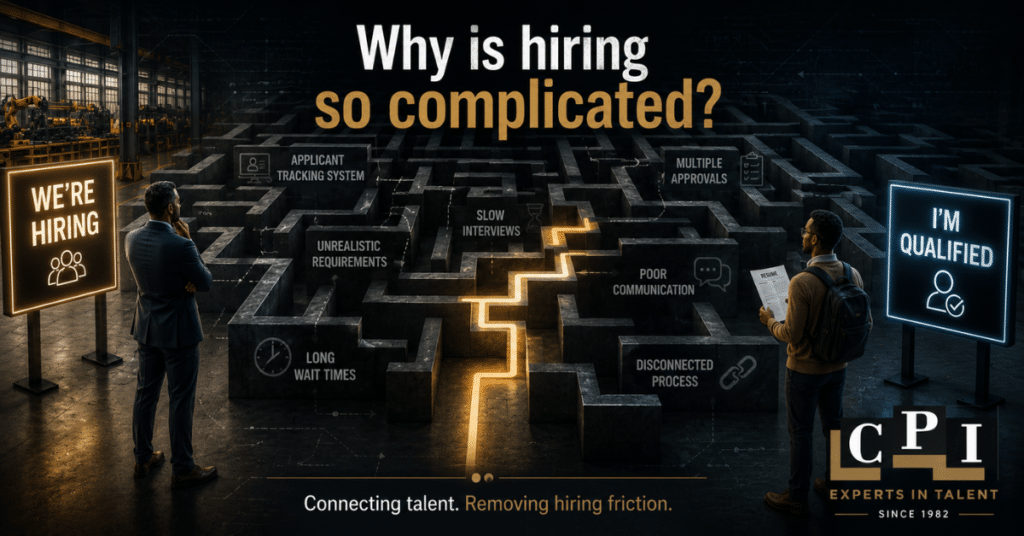
Across manufacturing, engineering, defense, skilled trades, and technology, employers continue searching for talent while qualified professionals continue searching for opportunity. Those two realities shouldn’t exist at the same time, yet they define today’s labor market. For years, conversations about recruiting have focused on labor shortages. Although workforce shortages certainly exist, they do not tell the entire story. Today’s hiring challenges stem from something much larger: a hiring process that has become increasingly complex, slower, and less personal.
Companies that recognize this shift—and adapt to it—will have a significant competitive advantage in the years ahead.
Why the Great Hiring Disconnect Isn’t About People Who Don’t Want to Work
Many people believe today’s hiring challenges exist because fewer people want to work. While that explanation makes for a convenient headline, it overlooks what is really happening.
According to the U.S. Bureau of Labor Statistics, demand for skilled professionals in manufacturing, engineering, healthcare, construction, and technology is expected to remain strong throughout the coming decade. At the same time, experienced employees continue retiring while technology rapidly changes the skills employers need. That combination creates legitimate hiring pressure for businesses across nearly every industry.
However, labor shortages explain only part of the problem.
Many organizations still rely on hiring processes that were designed for a workforce that no longer exists. Job descriptions have become longer. Interview processes have expanded. Approval chains have grown more complicated. Candidates often wait weeks for updates while employers wonder why they continue losing top talent to competitors.
The issue isn’t simply that companies cannot find people.
The issue is how companies hire people.
That distinction sits at the heart of the Great Hiring Disconnect.
The Great Hiring Disconnect Begins With the Search for “Perfect”
Most hiring managers don’t intentionally make hiring more difficult. They want to make thoughtful decisions, protect their organizations, and avoid expensive hiring mistakes. Those goals make perfect sense.
Unfortunately, they often create unintended consequences.
Over time, “qualified” quietly becomes “perfect.”
Five years of experience becomes ten.
Preferred qualifications become required.
Industry experience becomes non-negotiable.
One interview becomes four.
Eventually, the search becomes so narrow that very few candidates qualify, even though many could perform the job successfully.
We see this every day.
Many employers unknowingly create what recruiters call purple squirrel hiring—the search for an almost mythical candidate who possesses every desired skill, every certification, and every ounce of experience. While organizations continue searching for perfection, exceptional candidates accept offers from employers who recognize potential instead.
That isn’t a talent shortage.
It’s a hiring strategy problem.
Every time employers narrow their search beyond what the role truly requires, they make the Great Hiring Disconnect even wider.
Why Great Employees Rarely Match Every Requirement
Think about the strongest employee on your team.
Did that person know everything on the first day?
Probably not.
Someone recognized potential before the résumé reflected it. Someone invested time in training, coaching, and development. As a result, that employee became one of your most valuable contributors.
Today’s hiring market rewards organizations that continue making those investments.
Technical skills remain important. Experience matters. Certifications add value. However, adaptability, curiosity, accountability, communication, and problem-solving have become just as important because technology and business needs continue evolving.
Those qualities don’t always appear in an applicant tracking system.
Instead, they emerge through conversations, thoughtful interviews, and real-world examples.
That’s why technology should support hiring—not replace human judgment.
Artificial intelligence can identify keywords.
It cannot recognize determination.
Algorithms can organize applications.
They cannot measure character, resilience, or leadership potential.
The best hiring decisions still require experienced people who know how to evaluate people.
Organizations that understand this principle consistently reduce the Great Hiring Disconnect because they hire capable people rather than perfect résumés.
The Great Hiring Disconnect Rewards Employers Who Move Faster
Many organizations still believe taking more time leads to better hiring decisions. In reality, unnecessary delays often produce the opposite result.
Today’s strongest candidates rarely remain available for long. Highly qualified professionals frequently receive multiple interviews within days—not weeks. They evaluate employers just as carefully as employers evaluate them. When one company communicates consistently while another remains silent, candidates notice.
Silence communicates something, too.
Organizations that consistently attract top talent don’t necessarily move recklessly.
They move decisively.
They review résumés promptly.
They schedule interviews efficiently.
They communicate clearly.
They respect candidates’ time.
Most importantly, they understand that every unnecessary delay creates another opportunity for a competitor.
Companies that remove unnecessary friction don’t simply hire faster.
They reduce the Great Hiring Disconnect while building a reputation as employers that talented professionals genuinely want to work for.
Every Open Position Carries a Cost
Many organizations believe waiting another few weeks will produce a stronger candidate. Occasionally, it does. More often, however, the delay creates new problems that ripple throughout the business.
Projects fall behind schedule. Existing employees absorb additional responsibilities. Managers spend more time interviewing and less time leading their teams. Customer service begins to suffer, deadlines become more difficult to meet, and employee burnout quietly increases.
The financial impact extends well beyond the salary of the vacant position.
As we discussed in The Hidden Business Impact of Vacant Roles, every open position carries direct and indirect costs that affect productivity, morale, customer satisfaction, and long-term growth. While hiring carefully remains important, waiting indefinitely often becomes the more expensive decision.
Successful organizations recognize that every hiring decision involves some level of risk. Instead of trying to eliminate all uncertainty, they gather the right information, evaluate potential, and make informed decisions before exceptional candidates move on.
Technology Should Support Hiring—Not Replace It
Technology has transformed recruiting in remarkable ways. Applicant tracking systems organize thousands of applications, artificial intelligence identifies relevant skills, and automation reduces repetitive administrative work. These tools save time and improve efficiency when organizations use them appropriately.
Problems arise when technology replaces judgment instead of supporting it.
A résumé tells only part of a candidate’s story. It cannot measure resilience, curiosity, coachability, or the ability to solve unexpected problems. Likewise, an algorithm cannot always recognize transferable skills that may prove more valuable than direct industry experience.
The best hiring decisions still combine technology with experienced recruiters and engaged hiring managers who understand both the role and the person behind the résumé.
Technology should make hiring smarter.
It should never make hiring less human.
How Employers Can Close the Great Hiring Disconnect
Closing the Great Hiring Disconnect does not require organizations to lower their standards. Instead, it requires them to remove unnecessary barriers that prevent qualified people from entering the conversation.
Organizations that consistently hire exceptional talent tend to follow several common practices.
They define the skills that truly matter instead of creating unrealistic wish lists.
They streamline interview processes so qualified candidates do not lose interest before receiving a decision.
They communicate consistently throughout the hiring process, even when they have no major updates to share.
They evaluate potential alongside experience, recognizing that great employees often continue developing long after they accept an offer.
Most importantly, they empower hiring managers to make timely decisions instead of allowing unnecessary delays to become part of the hiring culture.
These organizations understand that improving the candidate experience also improves business results.
The Future of Hiring Will Belong to Adaptable Organizations
The workforce will continue evolving throughout the coming decade. Artificial intelligence, automation, advanced manufacturing, and digital technologies will reshape job requirements across nearly every industry. Companies that embrace change will continue attracting talented professionals, while organizations that cling to outdated hiring practices will find recruiting increasingly difficult.
We explored this changing landscape in Future Factory Manufacturing Jobs in 2035, where we discuss how technology continues to redefine manufacturing careers and the skills employers will need in the years ahead.
The organizations that succeed will not necessarily hire the most experienced people.
They will hire the people who learn the fastest, adapt the quickest, and continue growing throughout their careers.
That shift has already begun.