When most people think about the jobs behind AI, they picture software engineers, data scientists and AI developers.
But artificial intelligence needs much more than code.
AI needs buildings. It needs enormous amounts of electricity. It needs cooling systems, advanced semiconductors, sophisticated manufacturing equipment and miles of electrical and networking infrastructure.
More importantly, all of it needs people.
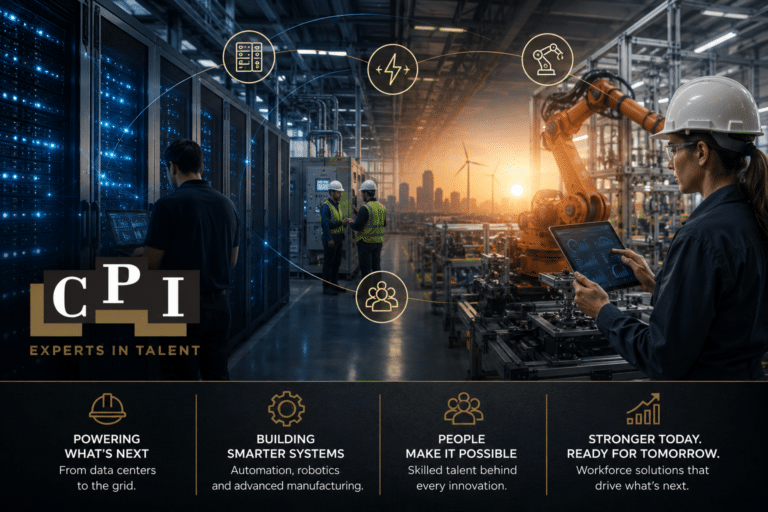
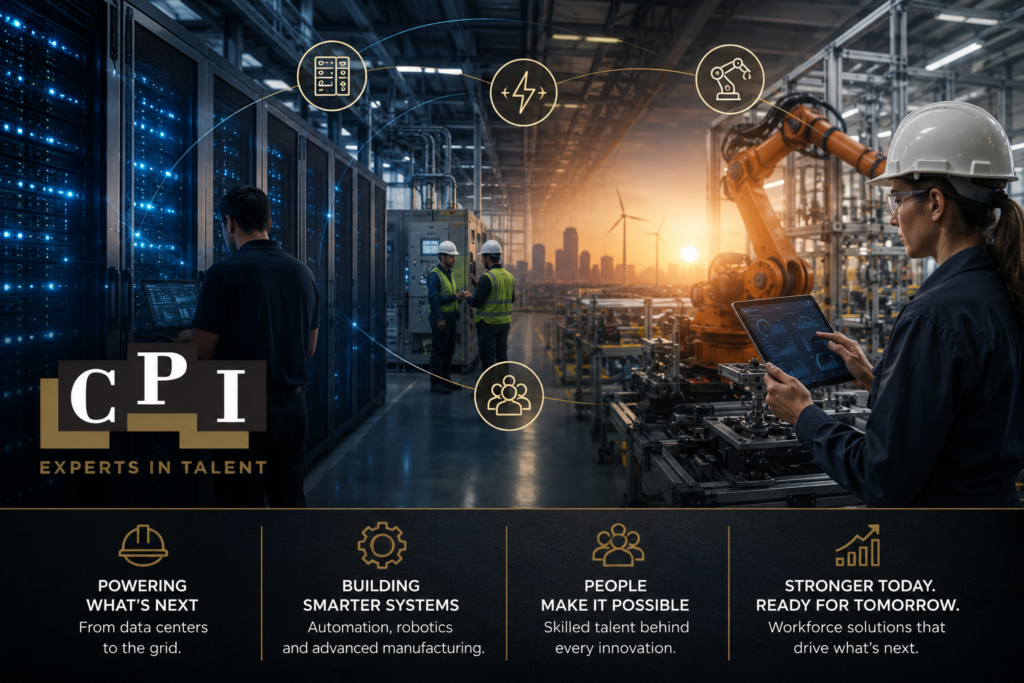
Behind the AI revolution is a workforce of electricians, engineers, technicians, mechanics, automation specialists, construction professionals and skilled tradespeople who are quite literally building the infrastructure that makes AI possible.
The Jobs Behind AI Aren’t All Tech Jobs
The conversation about AI and employment usually starts with one question: Which jobs will AI replace?
Instead, perhaps we should also ask another one:
Which jobs will AI create more demand for?
The physical scale of AI provides part of the answer.
According to the U.S. Department of Energy, data centers could account for 11.8% of total U.S. electricity use by the end of the decade.
As a result, the continued expansion of AI creates an enormous infrastructure challenge.
Someone has to build those facilities. In addition, workers must connect them to the electrical grid, install cooling systems, maintain equipment and keep complex operations running around the clock.
Those workers represent another side of the AI economy.
Building the Infrastructure Behind the Technology
A modern data center doesn’t appear simply because a technology company buys more servers.
Before those servers ever turn on, teams must develop the site, construct the facility, establish power capacity, install electrical systems, build cooling infrastructure and connect thousands of pieces of equipment.
Consequently, the expansion of artificial intelligence creates demand far beyond traditional IT.
Data centers need construction professionals, equipment operators, electricians, technicians, engineers and other skilled workers. Once a facility becomes operational, the workforce changes rather than disappears. Engineers, facility managers, technicians and maintenance professionals must keep sophisticated systems running.
In other words, many of the jobs behind AI won’t involve developing an algorithm.
Instead, they’ll involve keeping the physical infrastructure behind that algorithm running.
Skilled Trades Are in Growing Demand
We’re already seeing signs of this shift.
Electricians provide an excellent example.
The U.S. Bureau of Labor Statistics projects employment of electricians to grow 9% from 2025 to 2035, much faster than the average for all occupations. BLS expects approximately 72,700 electrician openings each year over the decade.
More significantly, BLS directly connects artificial intelligence and data-center growth to future opportunities for electricians.
As AI technologies increase electricity demand, the nation will need to upgrade the power grid and add infrastructure. Consequently, electricians will be needed to install and connect electrical systems and new power-generation sources.
That’s an important part of the AI employment story.
AI may automate certain tasks. At the same time, building the infrastructure that supports it creates demand for people who work with their hands, solve technical problems and keep physical systems operating.
Advanced Manufacturing Has a Major Role to Play
Data centers are only one part of the story.
AI also depends on an enormous manufacturing ecosystem.
Companies need semiconductors, servers, electrical equipment, cooling systems, backup power equipment, networking hardware, sensors and countless other components.
Meanwhile, manufacturers themselves are adopting more AI, robotics and connected technologies.
The World Economic Forum’s Future of Jobs research found that 81% of advanced manufacturing employers surveyed expected to adopt AI technologies. In addition, 69% anticipated adopting robotics.
Those employers also expect growing demand for AI and big-data skills alongside systems thinking, cybersecurity, design and other capabilities. Furthermore, the research found that advanced manufacturers expect to upskill 29% of workers in their current roles and reskill or redeploy another 15%.
That combination could change manufacturing jobs rather than simply eliminate them.
For example, maintenance technicians will troubleshoot increasingly sophisticated equipment. Automation technicians will support connected production systems. Engineers will use AI-assisted tools to analyze performance. Likewise, robotics specialists will install, program and maintain automated equipment.
As factories become more intelligent, the people supporting them will need broader technical capabilities.
The Workforce Behind AI May Become the Bottleneck
Technology can scale quickly.
Workforce pipelines cannot.
Companies can order equipment, secure financing and announce new facilities. However, developing an experienced electrician, technician, engineer or skilled trades professional takes time.
Therefore, workforce availability could become a constraint on AI growth.
The challenge becomes even clearer when we look at energy.
The Department of Energy says the rapid expansion of data centers is contributing to substantial electricity-demand growth. Current projections estimate that data centers could consume between 9.5% and 15.3% of total U.S. electricity by 2030, with 11.8% as the central estimate.
That power has to come from somewhere.
As a result, the jobs behind AI extend beyond the walls of a data center. Power generation, transmission, electrical infrastructure, manufacturing and facility construction all become part of the equation.
America’s AI ambitions may ultimately depend on something decidedly human:
Do we have enough people with the skills to build them?
Where Technology and Skilled Trades Meet
For years, conversations about the future of work often separated technology jobs from skilled trades.
Today, that distinction is becoming increasingly outdated.
Consider an electrician working on a hyperscale data center. Or a robotics technician maintaining an automated manufacturing line. Similarly, think about an HVAC specialist supporting sophisticated data-center cooling or a controls engineer integrating intelligent equipment.
Are those skilled-trades jobs or technology jobs?
Increasingly, they’re both.
In fact, advanced technology is changing the work itself.
Electricians aren’t simply pulling wire. Technicians aren’t simply repairing machines. Instead, many workers now interact with sensors, controls, automation, sophisticated diagnostics and digitally connected systems.
Manufacturing provides another good example. As employers adopt more robotics and artificial intelligence, they also expect increased demand for systems thinking, cybersecurity, design and other technical capabilities.
Consequently, employers may need to rethink some traditional ideas about blue-collar and white-collar work.
The people building the future may increasingly need skills from both worlds.
Employers Need to Start Planning Now
Companies investing in AI should think about workforce planning alongside their technology strategy.
That doesn’t mean every organization needs an “AI workforce.”
Rather, leaders should identify the occupations that their technology investments will affect.
Which skills will become more important?
Which employees can be upskilled?
Where will experienced workers become difficult to find?
Which positions require years of technical development?
Where could talent from adjacent industries transfer successfully?
By answering those questions early, employers will have more options.
Companies should also reconsider where they look for talent. For example, professionals from advanced manufacturing, power generation, utilities, industrial construction, defense and other technically demanding industries may have transferable skills.
However, broadening the talent pool doesn’t mean lowering standards.
Instead, employers need to determine which experience is truly essential, which capabilities predict success and which skills someone can realistically learn.
That distinction will become increasingly important as technology changes faster than traditional job descriptions.
Ultimately, organizations that wait until a facility opens or equipment arrives may discover that the hardest resource to secure isn’t technology.
It’s talent.
The Jobs Behind AI Are Already Here
The future workforce isn’t something we need to imagine.
Parts of it are already here.
Electricians are expanding power infrastructure. Engineers are designing facilities. Technicians are maintaining automated systems.
Meanwhile, manufacturing teams are producing increasingly sophisticated equipment. Skilled trades professionals are building the physical infrastructure required to support growing computing and energy demand.
At the same time, manufacturers are preparing their existing employees for a more technology-intensive workplace. The World Economic Forum’s research shows significant expectations for both upskilling and reskilling within advanced manufacturing.
Those aren’t jobs happening despite AI.
Rather, they’re part of the economic activity growing around it.
That’s why the conversation about AI and employment needs to become broader.
We should certainly ask how artificial intelligence could change existing jobs. However, we should also recognize the enormous workforce required to make AI possible in the first place.
Who Will Build the Future?
AI will continue to change work. Some tasks will disappear, others will evolve, and entirely new occupations will emerge.
However, focusing only on what AI might replace misses half the story.
The AI economy still depends on people.
It needs engineers who design complex systems, electricians who power them, technicians who maintain them, skilled trades professionals who build them and manufacturing teams that produce the physical technology behind them.
For employers, that creates both an opportunity and a warning.
Organizations may invest billions in artificial intelligence, automation and infrastructure. Yet they will still compete for a limited supply of people who know how to make that technology work in the real world.
At CPI, we work across defense, engineering, manufacturing, IT and other technical markets where many of these workforce changes are already taking shape.
As technology evolves, our focus remains the same: helping organizations find the people with the skills to move their business forward.
Because when we talk about the jobs behind AI, the biggest question may not be what artificial intelligence can build.
Ultimately, it’s whether we’ll have enough skilled people to build the future around it.